Insight
Should B2B Marketers Care About AI Voice Agents?

21 October 2026 Marketing Technology
AI voice agents have taken big strides in the last couple of years. The robotic “press 2 for account issues” phone tree is being replaced by something that listens, understands, and answers almost like a person. They’re called AI SDRs (Sales Development Representatives), and they’re tipped to be the next big thing in B2B marketing.
AI Voice Agents in 2026
AI SDR capabilities have reached a new threshold. The better support agents are now capable of holding a real conversation with customers. They draw on CRM, helpdesk, chat records, and customer data to answer questions and solve problems in real time.
They can even make outbound calls triggered by customer signals.
Some AI voice agent providers claim to achieve the same conversational latency as humans, as well as the ability to detect emotion.
For us and our clients, it’s not a question of whether AI will be used to proactively engage leads. We’re more interested in what’s going to happen to B2B customer experiences when AI voice agents go mainstream.
Are Customers Picking Up AI’s Call?
Service professionals appear roundly impressed with the performance of conversational AI (including voice agents and chatbots). Almost 4 in 5 say it increases self-service resolution rates, speeds up resolution time, and improves accessibility.
Customers seem to be on board as well.
- 51% prefer interacting with AI over humans for immediate service
- 56% say AI agents help them better understand products
- 47% feel AI can be empathetic when addressing concerns
Source: Zendesk
Little wonder the market for ai voice agent services for businesses is forecast to grow by £8.25bn ($10.95bn) between 2024 and 2029, a CAGR of 37.2%.
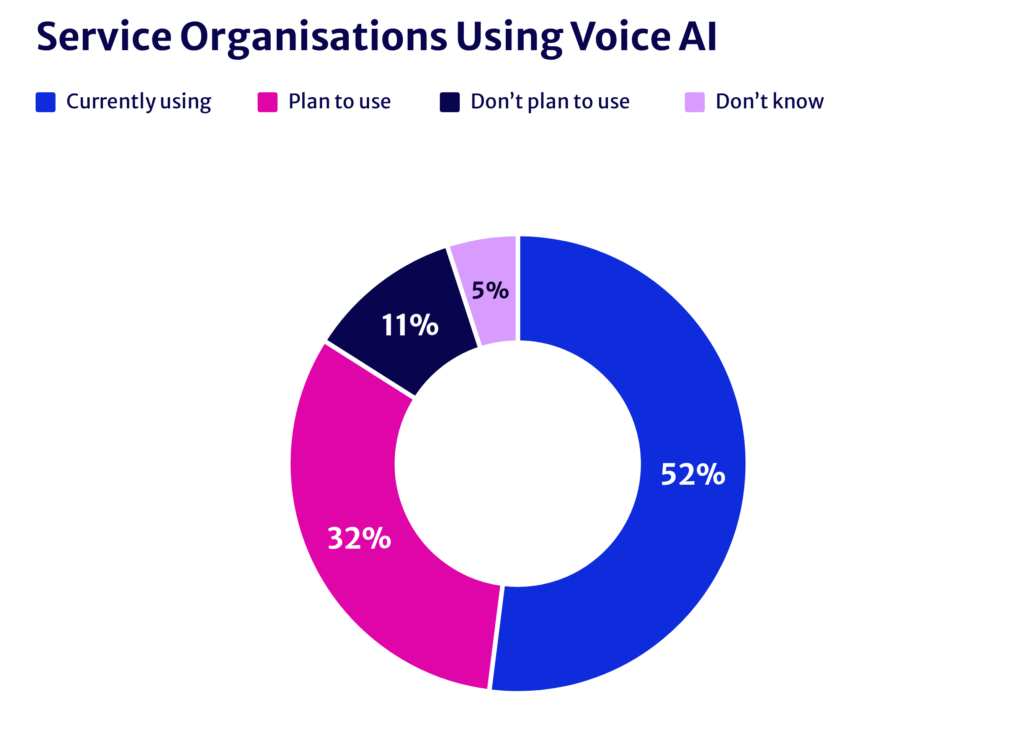
Source: Salesforce State of Service, 7th Edition.
What Happens to B2B Marketing When the CRM Starts the Conversation?
Faster Response Times
The best enterprise sales teams get back to an opportunity within 8 minutes. The average response time? 52 hours.
AI SDRs cut that wait time down to seconds. They engage while intent is still high rather than two days later.
Context-Rich Conversations
Crucially, CRM voice integration feeds the outcomes of each interaction back into the system.
Sales teams get more information to intervene at the right time. Marketers can test which intent signals are valid and valuable. Customers can call any time and pick up the conversation where they left off.
A More Level Playing Field
Although vendors are betting on enterprise AI adoption skyrocketing in the coming years, we’re quietly betting that small businesses will be faster off the line.
There are fewer approval layers, platforms, data sources, compliance requirements, and operational dependencies.
Rushing into agentic AI adoption carries risks for any business. Still, the smart teams are scoping pilots and experimenting in sandboxes. Waiting too long is also a risk.
5 Places Voice Agents Earn Their Place in a B2B CRM
Positioning an Offer
AI SDRs create more responsive, personalised, and seamless conversion opportunities. The friction of filling in a form or trudging through a nurture sequence disappears.
Early-Stage Lead Qualification
AI voice agents are especially well suited to early lead qualification. As a result, human teams spend less time chasing poor-fit enquiries and more time on the conversations that need judgement.
The balance of human and AI involvement is critical here. Voice AIs work best when they are connected to a clear view of the account, not just a single form filled out on the website. At the same time, delegating too much of the process to an AI SDR will turn prospects off.
Xavi Armengol, Technical Consulting Leader
Context-Rich Sales Enablement
AI SDRs don’t get tired or skip questions. They ask (and log) the same questions for every prospect call. They can be configured to capture the data your sales team needs to orchestrate a meaningful follow-up.
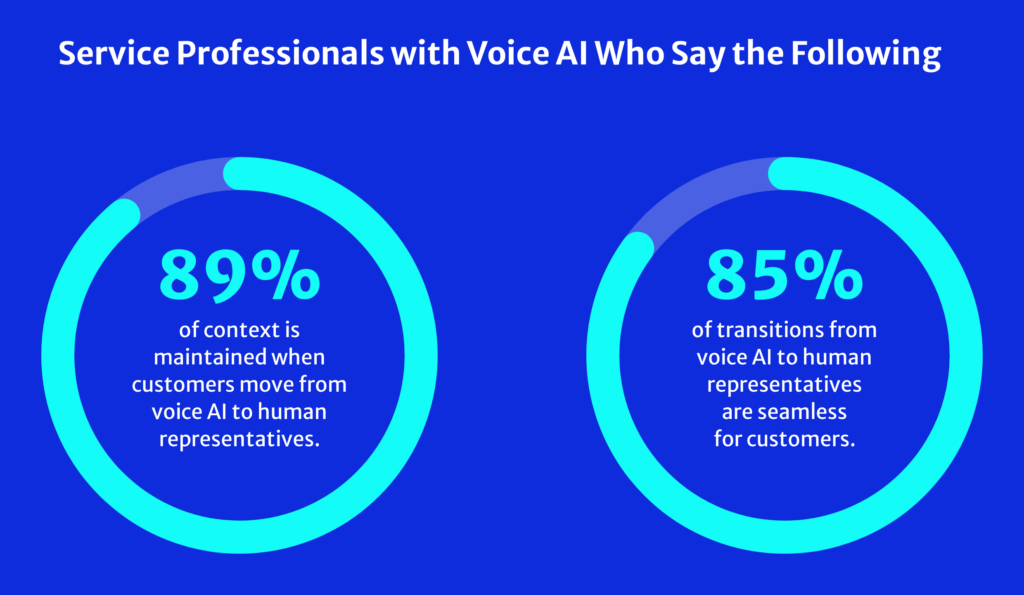
Source: Salesforce State of Service, 7th Edition.
Triage
Nobody expects AI to solve every issue. But more than one customer survey suggests people are happy to speak to an AI for simple troubleshooting issue or after-hours support.
Appointment Setting and Follow-Up
A lot of pipeline leakage is administrative: missed calls, slow follow-up, calendar back-and-forth.
AI voice agents can handle meeting bookings, reminders, rescheduling, and post-event engagement.
Pipeline Reactivation
Most CRMs contain dormant leads that sales teams don’t have time to work through. A voice agent can support structured reactivation:
- Checking whether the lead still exists
- Asking whether needs or priorities have changed
- Offering a relevant next step
- Updating the CRM record
If there is fresh intent, a human can take over.
Risks and Realities: Where AI Voice Agents Go Astray
Like with any agentic AI application, the business case for AI SDRs is strongest when there is:
- A narrow and tightly defined use case
- A repeatable task
- Reliable, fresh data
Clear handover and humans in the loop
That is a narrower brief than many vendors would like you to believe. The reality, though, is that any AI agent is only as good as the data and the processes behind it.
Your Data Has to Be Right
A voice agent acts on whatever the CRM tells it. If your records are stale, duplicated, or missing context, the agent will act on that bad information and blow the deal.
When it starts down the wrong path, the same speed that makes AI useful will amplify a mistake fast.
Data is where most AI projects fail. You need to invest time and effort into consolidating and updating customer data before trying to integrate a voice agent into the CRM.
Xavi Armengol, Technical Consulting Leader
Compliance Is on the Line
If an AI agent breaches the rules around consent, call recording, data handling, and do-not-call lists, your company is likely to be liable. Not the vendor.
Governance Can’t Be an Afterthought
Who signed off on the script? What is the agent allowed to promise on pricing or terms? When does it escalate to a human, and how is that handover logged?
Without clear guardrails, a voice agent might say something you never approved.
Not Every Customer Wants the Call
When it comes to designing good customer experiences, the channel and moment matter as much as the message.
Some buyers will happily talk to an agent for a quick answer. Others find an unprompted AI call intrusive. Pick your moment carefully based on observed customer challenges or service bottlenecks.
Irresponsible Adoption
AI SDRs don’t replace human teams. The idea of replacing a full team with AI should not even be on the table. Start with a controlled pilot around a single use case like after-hours qualification or appointment-setting. Test, measure, and learn before expanding.
Complex Cases Still Need a Person
A voice agent is good at repeatable top- and middle-funnel cases. Escalation to a human is still critical for sensitive or judgement-based interactions like pricing disputes, churn risks, frustrated accounts, and complex questions.
“Set and Forget” Is Certain Failure
An agent cannot be left unmonitored. Products change. Offers expire. Key accounts move on. AI needs a named owner and regular reviews, including quality and compliance audits.
Where an AI Voice Agent Fits in Real B2B Organisations
A successful AI voice agent project probably won’t start with “let’s build an AI SDR”. It would start with discovering where leads are waiting too long, where salespeople lose time, which customer moments are repeatable, and where data lives or is missing.
From there, Tap CXM can help you pilot a targeted use case:
- Identify a clear pain point or opportunity
- Connect the right data sources
- Define the brand voice and guardrails
- Test the customer experience
- Measure whether it impacts customer value KPIs
How this looks from a technical standpoint depends on your existing stack.
Salesforce has gone the furthest (at the time of writing, among enterprise martech platforms), releasing Agentforce Voice to handle inbound and outbound qualification, automate engagement, book meetings, and log calls data to the CRM.
For other marketing automation platforms – Adobe Campaign, Braze, HubSpot, Marketo Engage, Iterable, Bloomreach, and the rest – you’ll need to trigger a third-party AI voice agent via API or webhooks.
The call itself runs on a dedicated voice platform, with data feeding back into your engagement platform, where campaign logic lives.
So, Should You Care About AI Voice Agents in B2B Marketing?
Yes, but not just because it means a 24/7 support line.
Anyone in B2B CXM should be paying close attention to AI SDRs, especially in use cases where simple unforced errors are turning customers away.
However, voice isn’t right for every journey. It’s not a replacement for complex sales, strategic account management or human judgement.
But it is a strong candidate for repeatable moments where speed, consistency, and a contextually aware conversation can improve the customer experience.
If you’re looking to create more consistent, seamless customer experiences that drive loyalty and ROI, let’s talk. We help B2B (and B2C) teams identify and implement value-adding AI use cases.
You might also like these