Insight
Decisioning in Marketing: What It Is, What It’s For, and How to Start

18 November 2026 Customer Experience Management
Decisioning in marketing is the process of choosing the next best experience for each individual, using customer data, business rules, and AI models. That’s the textbook definition. After years of helping brands put it into practice, I’d argue the purpose of decisioning is optimisation and incrementality. Discovering diversity in your data set, finding what works, and doing more of it, creating a cycle of continuous and provable uplift. At the heart of the system is a decisioning engine. But the projects I’ve seen succeed do so with unified data, shared goals, AI governance, and a record of every decision.
What Is Decisioning in Marketing?
Decisioning is the process of choosing the next best experience for a customer or individual using relevant data, business rules and, where useful, AI models.
The way I explain it to clients is that decisioning runs on the answers to three questions:
- What do we know about this customer?
- What are all the possible things we could do for them?
- Which option is most likely to create value in this context?
Somewhere in the system is a decisioning engine. It’s the tool or platform that scores or ranks the approved options (including doing nothing) against a customer record, returns a choice to the engagement platform, and uses outcome data to improve future choices.
I need to say this early because it’s usually where decisioning conversations start: the tool is not the point. Decisioning, in my experience, is a game of discovery, diversity, optimisation, and incrementality.
Discovery means learning what makes a difference, for whom, and in which circumstances. It means challenging your starting assumptions. Testing gives you evidence to improve them.
Diversity within your data set helps you understand the why behind what you discover. Even within the skinniest audience segment, two individuals won’t respond the same way to the same decision. Decisioning enables marketers to discover and deliver experiences that work for an audience of one, while retaining the structure of audience segments.
Optimisation uses what you learn to allocate more activity to the choices that create value, while continuing to explore alternatives. That can range from a well-timed discount offer to reducing contact or removing an unnecessary journey step.
Incrementality is the value you get from a decision that you wouldn’t have got without it. A conversion following a message tells you what happened. A well-designed comparison helps establish what the message changed. For example, a discount might reward customers who would have bought anyway. A strong response rate can hide lost margin.
The purpose of decisioning is incrementality and optimisation. Making decisions is how you get there.
This might seem academic, but it changes how you assess and assemble decisioning capabilities.
A system built to deliver personalised customer experiences at scale is measured by how many personalised customer experiences it delivers. A system built to optimise gets measured on the value it adds.
What Decisioning is Actually For
It’s easy to assume decisioning is about making decisions. That’s how a lot of vendors sell it: more decisions, made faster, at scale, with human oversight but not effort.
That’s the mechanism. It’s not the model.
I think of decisioning as a fractal approach, with each interaction split into smaller sub-decisions:
- Context: What’s happening for this customer right now?
- Offer: Which proposition, if any, is worth making?
- Content: Which message or creative suits them?
- Channel: Where is the best place?
- Timing: How soon should it launch and when should it land?
Naturally, there are hundreds of variations for every individual at any given touchpoint. Scaled over thousands of customers (if not millions), it’s not something humans can manage.
That’s the value of decisioning. It finds what works for each person, feeds data back, and keeps improving engagements over time.
This raises the question: how many journey variants do you need? Three is probably too few. Ten thousand is too many.
In reality, you won’t know until you test and discover how diverse your audiences really are.
Audience-Based Journeys vs Decisioning
Audience-based journeys follow pre-defined paths. They can be linear or branching, but they’re always governed by rules that someone wrote in advance. Everyone who meets certain criteria gets the same treatment.
Decisioning engines work dynamically, in real time. Instead of making one choice for an entire segment at set points, decisioning treats everyone as an individual.
In other words, journeys guide customers along a route you’ve planned. Decisioning works out the best next step for each customer as they go.
Performance Isn’t a Game of Inches
When I work with clients on customer decisioning projects, I usually end up asking customer teams to rethink how they measure success.
Clicks and conversions alone aren’t enough. Incrementality – the difference marketing makes compared to doing nothing – is only measurable against a control group that doesn’t receive the decision.
Results from decisioning also don’t arrive evenly. You won’t see a uniform change across every channel.
Instead, you’ll discover pockets of value and a few dead-end initiatives (hopefully more of the first).
Once you identify those pockets, you can direct more effort to experiences that deliver value and continue optimising to get better results.
All of this may challenge the usefulness of classic KPIs in marketing, sales, and service.
Classic offer decisioning uses a propensity-times-value calculation. That’s still useful in some scenarios, but incrementality is really the best practice in modern AI-powered decisioning systems. It’s allowing customer teams to get closer to the customer and orchestrate more dynamic journeys, rather than using static rules and broad predictions.
Why Decisioning, and Why Now?
Marketing is moving away from batch-and-blast campaigns towards journeys curated for a single customer. You’ve been hearing that for at least a decade. Us too, and we’re still yet to see it fully realised.
The difference is that now we actually have a shot at delivering true 1:1 marketing at scale.
The Technology Barrier is Gone
Serious decisioning used to need a Pmega-sized budget. Not anymore.
Braze launched self-serve AI decisioning agents in October 2026. Adobe Journey Optimizer offers AI ranking for offers and content. Hightouch, Bloomreach, Klaviyo, Tealium, Twilio Segment, and many more marketing automation platforms have rolled out AI-powered decisioning capabilities in 2025 and 2026. Even Pega’s Customer Engagement Studio uses AI agents to help marketers build and run campaigns.
In short, decisioning is one place where AI will make a real impact in marketing. Gartner predicts that at least 15% of day-to-day work decisions will be made by AI agents by 2028.
A lot of the AI conversations my colleagues and I have with clients turn out to be decisioning conversations. They ask for AI. What they usually want is better decisions.
Martech Consolidations Bring Two Systems Into One
Most brands run two separate systems:
- Audience platforms (CDPs, campaign and journey tools) decide who to talk to. They work in batches.
- Decisioning engines decide what to do for one person. They work in real time, acting on behaviour signals and customer context.
The two rarely worked together in the past. Each kept its own copy of the customer. The different teams running them competed for the same customer and budget. Audiences refreshed on a daily schedule, while decisioning needed answers in milliseconds.
That’s changing. Vendors are consolidating audiences and decisioning into one platform, with analysts predicting that these all-in-one “data platforms” will be the future.
I tend to agree, although my timeline differs slightly. But there’s no doubt the consolidation, supported by data management and AI agents, will enable more brands to move from audience-based campaigns to always-on, 1:1 interactions.
You only need to look at Salesforce acquiring Braze for $5.6bn and Hightouch’s newly-built engagement capabilities, both announced in October 2026. Or Adobe’s moves from audience-based platform to customer-centric decisioning ecosystem with Journey Optimizer and Real-Time CDP, plus the August 2026 announcement that Audience Manager will be decommissioned.
I’m certainly not alone in predicting that the next era of customer experience management will be run from consolidated tech stacks and accelerated by agentic AI.
We think that marketing stacks will continue to consolidate. But maybe not in the way most people anticipate…This is a time of significant disruption in martech, but it’s also an incredibly exciting time to be working in marketing.
Tejas Manohar, Hightouch Co-CEO via LinkedIn.
Campaigns Still Have a Role
Campaigns start with what the organisation wants to say – or, if we’re being honest, what it wants to sell.
Realistically, that’s going to stay the way things go for at least the next few years. Introducing decisioning within existing campaigns makes the important moments more valuable.
Journey orchestration still handles sequencing and delivery. The engine evaluates the options, replacing an overgrown web of manually maintained paths.
The opportunity is to make campaigns part of a more responsive, connected system. Eventually, in an ideal world, marketing would move beyond campaigns entirely. Teams need to judge how they change against customer and commercial outcomes, rather than protecting a monthly send target.
Personalisation vs. Decisioning
Gartner found that 53% of customers have had a negative experience with personalised marketing. Those customers were 3.2x more likely to regret a purchase.
Personal doesn’t always mean welcome, and addressing a customer by name in a campaign email isn’t the same as decisioning.
Good decisioning assesses every element of every experience. It knows how and where to deliver a message, when to hold back, and when a helpful service note will do more than another offer.
The Decisioning Tree
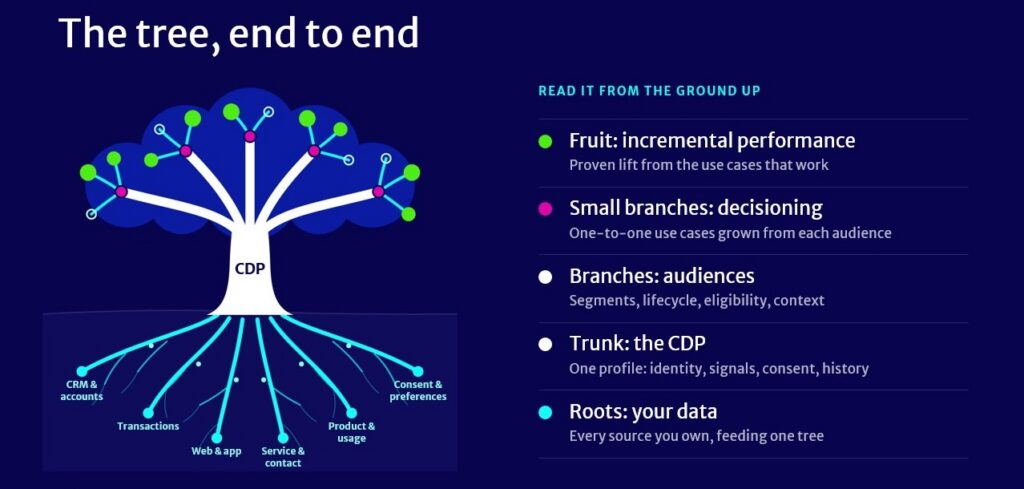
Decisioning relies on data, audiences, and individual choices working together to produce incremental performance. That’s often hard to visualise. “Together” evokes the idea of a highway or parallel network, when in reality decisioning is more like a tree.
Roots: Your Data
Trees only grow as well as they’re fed, and it’s no different for our metaphorical decisioning tree. Healthy roots mean every source you own feeds the same trunk.
| Source | What it tells you |
|---|---|
| CRM and accounts | Who they are, what they own |
| Transactions | What they buy, and when |
| Web and app behaviour | Browsing, searches, drop-offs |
| Service and contact | Calls, chats, complaints |
| Product and usage | How they really use it |
| Consent and preferences | What they’ve said yes to |
| Loyalty and rewards | Points, tiers, redemptions |
| Offline and partner | Stores, events, third parties |
Service data is one that brands tend to leave out. It’s often made up of semi-structured or unstructured data like form fields and call logs.
At the same time, many of these data sources were collected but not actionable at the speed customers wanted. That led to gaps in experiences and more than 50% of customers feeling like they’re communicating with different departments or repeating information to different representatives.
Trunk: The CDP
The trunk pulls the roots together into one customer profile, then feeds every branch from it. This happens in three stages:
- Unify: Identity resolved across every source and device.
- Enrich: Behaviour, transactions, preferences, and consent brought together.
- Serve: The same profile serves both audiences and real-time decisions.
This doesn’t have to be a standalone platform or even a composable CDP. The requirement is a usable, consistent profile with updates arriving quickly enough for the use case.
As stacks consolidate, a warehouse-native setup or a marketing cloud’s built-in data layer can do the same job.
A quick tip, though: An in-session web decision may need fresher signals than a renewal decision. Define your timings before speccing a real-time-everything platform.
Branches: Audiences
Audiences organise customers, giving the tree its shape. They establish where a use case applies and who is eligible by looking at key criteria.
- Segments: Groups formed by need, value, and behaviour.
- Lifecycle: New, growing, at risk, lapsed.
- Eligibility: Who can be offered what, and where.
- Context: Location, device, moment, intent.
Audiences tell you who to speak to. On their own, they can’t work out the next best experience for each person.
Small Branches: Decisioning
Each small branch is a use case growing out of an audience and a decision you can improve. The engine evaluates all available options to work out the best next step for each person:
- Next best experience: The thing worth doing now.
- Offer: Which proposition, at what price, including non-commercial experiences.
- Channel and timing: Where and when it lands best.
- Suppression: When the best action is to stay quiet.
- Arbitration: Weighing the customer’s needs against business value.
Audiences form the boundaries. Decisioning chooses within them. To do that, it needs an action library to choose from.
That library contains approved offers and experiences, along with the content, conditions, suppression rules, and delivery requirements for each. The engine’s job is to arbitrate between those available options using the agreed objective and constraints.
For a customer with an unresolved complaint, a useful service update may take priority over a promotion. For someone nearing the end of a contract, clear renewal steps might be enough without an incentive.
Fruit: Incremental Performance
When marketing bears fruit, it means it’s caused a better result than what would have happened anyway.
- Incremental revenue: Measured against a control group.
- Incremental retention: Customers who stayed when they would have left.
- Incremental margin: The same lift without bigger discounts.
- Contact efficiency: The same lift or better, with fewer messages.
To really prove that your fruit is sweet, you need a holdout group that doesn’t receive the decision. IAB’s incrementality guidelines call this a “credible counterfactual”. If a decision only wins with customers who would have bought anyway, it hasn’t added anything.
Not every branch will bear fruit. You test, measure, and keep what works, documenting as you go so you can define and prove the value of decisioning.
From there, you can focus resources on optimising valuable experiences to continue the cycle of continuous improvement.
Where the Decisioning Engine Sits
In practice, the decisioning engine can live in one of two places on the tree.
- In the small branches: Decisioning tools built into individual platforms, like Braze or Klaviyo, make choices at the touchpoint. You get speed and a lower cost.
- Alongside the trunk: A central decisioning brain, like Pega Customer Decision Hub, sits next to the customer data layer and sends decisions out to every channel. You get more control and consistency.
There’s no universal better option between a centralised decisioning brain and AI tools embedded at the touchpoint level. Every organisation’s decisioning system reflects how they operate and what their customers need.
How the Tree Works Day to Day
Every time a customer shows up, the same five steps happen:
- Feed data. The roots send data into the CDP, in real time where it matters.
- Set the audience. Audiences define who’s eligible and what’s allowed.
- Decide. For each person, the engine weighs every option and picks the best one.
- Deliver. Web, app, email or contact centre: one decision, carried out everywhere.
- Learn. Measure the lift against a control group, then feed the results back into your data.
The process repeats in a loop. Delivery and response data return to the profile and measurement layer. Every result becomes new data, and the tree gets a little healthier each time.
In a mature decisioning tree, channels share context so the next interaction always reflects what happened previously. That means coordinating experiences across every touchpoint, including service and support, rather than repeating the same message everywhere.
Core Requirements for Decisioning
There’s a lot more to decisioning than a decisioning platform. In fact, the technology is probably the easy part. Most projects that stall have perfectly good tech. What’s missing is the support to make it valuable.
A Unified Goal
Marketing, IT, sales, service and BI need to agree on:
- What improvement would be valuable.
- Over what period.
- How you will assess it.
The target outcome is usually customer lifetime value or something close to it. Increasing profitable renewals, for example, gives teams a more useful objective than increasing offer acceptance alone.
Without alignment, the engine ends up refereeing between departments. Sales wants revenue. Service wants survey data. Marketing wants to prove the value of personalisation at scale. In the end, the customer gets multiple conflicting messages on the same day.
Start with the outcome, then work backwards to the strategy and tactics. Build a system of decisions, data, actions, and testable tactics that support your outcome. I call this thinking right to left and building left to right.
This organisational alignment can often be the hardest part of a marketing project. But, as our work with a UK telco shows, it’s the secret to success.
Governance, Especially Around AI
AI adoption is moving faster than most teams’ ability to manage it. Before you let a model choose what customers see, establish an AI governance policy that covers:
- Eligibility
- Permitted actions
- Audience exclusions
- Human intervention
- Frequency limits
- Brand requirements
- Model monitoring
- Human approval
- Audit trail
There are certainly risks to rushing out agentic AI. But the biggest risk is doing nothing. At Tap CXM, our stance is that AI may well deliver on its promises for marketers, but only with humans at the helm – not just in the loop.
Forrester found that decisioning buyers are ranking audit trails and explainability higher on their lists, after Gartner predicted a 40-plus-per cent failure rate for agentic AI projects by the end of 2027, partly because of weak risk controls.
An Operating Model
Decisioning changes who does what, so it might change your operating model.
At a minimum, you need to name who owns the customer outcome and the people responsible for data, content, decision logic, and measurement.
Give them a workable process for approving changes and responding to exceptions. I’ll go into this in more detail shortly.
Receipts (Decision Data)
Receipts aren’t mentioned in most decisioning guides, which I find strange since they’re increasingly becoming core functionality in platforms.
Every decision should leave a record, ideally one that shows:
- Who the customer was and which audiences they were in.
- Which actions they were eligible for.
- The options considered and excluded.
- Which action the engine chose and the scoring or rationale behind it.
- What happened next (for them and for the control group).
Receipts let you investigate why something happened and connect touchpoint decisions to commercial results to prove incremental uplift.
They’re also useful for making sure that the programme is following its boundaries. You’ll need to establish access and retention rules, so you have useful and compliant records without holding unnecessary personal data.
The Supporting Tech Stack
The decisioning engine is only one piece of the system. It also needs:
- A data architecture that gets customer signals to the engine cleanly and on time.
- A content system that handles modular content, with enough variations to choose from.
- Channels that can ask for a decision and show the result on the fly.
The good news is that platforms are getting there quickly. Decisioning is being built into engagement platforms, and marketers can stand up decisioning agents without needing deep technical knowledge.
Just remember to get the basics right before trying to roll out organisation-wide agents. AI tends to amplify whatever foundations it’s built on, good or bad.
The Decisioning Operating Model: Humans, Agents, and Artefacts
A lot of decisioning projects stall because the company focuses on the tool and forgets everything around it. If you buy an advanced decisioning engine but keep working in product silos with monthly campaign sign-offs, you’ll end up using it as an expensive email blaster.
Decisioning works best with cross-functional teams that bring marketing, service, data, technology, analytics, and creative together around a customer need or journey. A Centre of Excellence team maintains the data, models, and creative, approves customer-facing assets, and investigates results.
Humans Own the Outcomes
Department heads set the strategy and guardrails. Each squad owns its journey and is given the autonomy to make decisions that align with organisational goals.
At the specialist level, the big skill shift is away from building new stuff to optimising what’s already out there. Mature customer teams spend a lot more time optimising than building.
AI Agents Run Human-Defined Tasks
AI agents are good at building things do repeatable processes. They’re not good at doing the repeatable process themselves.
Depending on the use case and tools, that repeatable process can be anything from compiling offers to configuring an experiment. I can’t stress this enough, though: the important decisions stay with people.
AI should choose from a set of pre-approved actions and use logic you’ve defined, not think for you.
Artefacts Make the Work Shared and Inspectable
Humans and algorithms work from controlled versions of the same assets. These include the action library, reusable content blocks, eligibility rules, contact policy, model documentation, experiment plans, and decision receipts.
Put simply, humans set the brief and boundaries, agents work with them, and artefacts keep a record of what happened.
Decisioning should never be pitched as a way to cut headcount. AI and automation should free up people’s time to do net-new things that weren’t possible before.
Thomas Fordham, Tap CXM COO
The Decisioning Recipe
Once the organisational requirements are in place, a working decisioning programme needs five key ingredients:
- Reach into the relevant channels. The selected action must be deliverable. Start with one channel, then connect more to discover diversity.
- A useful range of personalised recommendations. Include sales, service, information and no contact. Build modular content so approved assets can support different experiences without producing everything from scratch.
- Actionable signals that arrive in time. Define the events that warrant a decision and a timeline for action. Make sure the system can respond while the signal remains useful.
- Rules and AI decisioning. AI can uncover patterns and apply ideas at scale. It still needs a clear objective and a permitted action set. Models should choose within your guardrails and learn from the results.
- Measure from the first launch. Build in holdouts, receipts, and commercial outcome tracking. You need to see whether an action was delivered and whether it added value.
If you’ve used our framework for personalisation at scale, this will look familiar. Offer, message, timing, channel, and measurement remain the framework for any good customer experience. AI decisioning engines can’t function without it.
Decisioning Maturity: Crawl, Walk, Run
You don’t plant a fully grown tree. Successful decisioning programmes start small and build over time.
Maturing a decisioning programme means improving the decisions you can make and the value you can prove. It broadly follows the evolution from Next Best Offer marketing (NBO, personalised selling) to Next Best Experience management (NBX, curating journeys and experiences).
| Stage | Focus | What it looks like | Remember |
|---|---|---|---|
| Crawl (NBO) | Get the roots right | Audit and connect key data sources Resolve identity into a single customer profile Put the decisioning architecture in place Launch your first use case on one channel | Offer, timing or channel choices can reveal more commercial value than starting with minor copy variations Agree the baseline and holdout design before launch |
| Walk (NBA) | Join up audiences and decisions | Audiences set eligibility for decisioning Extend to two or three channels Balance service and sales messages Agree shared KPIs Show the first incremental improvement | Repeat useful decisions in other journeys Let evidence determine which opportunities receive more effort Retire activity that adds no value, even if it engages well |
| Run (NBX) | Bear fruit everywhere | Always-on decisioning across every channel, including paid media AI-led models governed by people Incremental lift proven on every use case | A mature programme can choose a service intervention or silence Keep checking whether established use cases still create incremental value |
Where to Start
Before step one, define the outcome you’re aiming for. That way you know where you’re pointing.
- Recreate a batch campaign as a triggered journey.
- Add one decision to a high-volume moment (cross-sell and upsell are the usual suspects).
- Start with channel, offer or timing, and use a holdout group.
- Add more decisions to the same journey based on the results.
While every marketer can cite the gold standard of automated, always-on customer experiences, few are confident taking the first steps from batch campaigns to triggered decisions.
It’s not something tech can magically solve.
Progress won’t be neat. You might be running in one channel and still crawling in another, and don’t be surprised if message volume drops with value still going up. That can feel uncomfortable, so plan for it and check in with your measurement model regularly.
How to Choose a Decisioning Engine
There’s more than one route to “run”. The right decisioning tech stack usually depends on your maturity.
- Starting out: Business rules on top of a CDP, mainly for eligibility and suppression. Many CDPs do this natively. Good for proving value, but you’ll hit a ceiling.
- Stepping up: Predictive scores like churn risk used inside journeys to pick the best path or message.
- High complexity: Central prioritisation that weighs propensity against commercial value across every channel, including paid media. This is the territory of enterprise platforms.
- Build your own: Businesses with large data science teams sometimes build on their cloud data warehouse for total control. It’s a lot of work to connect channels and give marketers a tool they can use day to day.
This is a general lay of the land, not a rule.
Start With What You Have
The best martech is often the platform you already own. Before you even think about buying new tech, check whether your existing stack can solve the problem with an upgrade or integration.
You can often add a decisioning layer or develop a more centralised capability without licensing a new platform.
One Engine or Several?
A central engine coordinates priorities and policies across channels. It gives you control and one place to audit everything.
Embedded decisioning lets teams improve particular moments within their existing tools. It’s quicker and cheaper to adopt, but harder to keep consistent across a journey.
Plenty of brands combine the two. That can work as long as goals, rules, and measurement are shared.
Comparing Vendor Capabilities
There’s no shortage of criteria, and it doesn’t help that vendors often tout features and performance that can’t be compared like-for-like.
That’s not necessarily a cause for frustration. In the end, the right stack is the one that supports your long-term business goals, not the one that triggers a decision half a millisecond faster than another platform.
That said, there are a few key areas to check when building a shortlist of decisioning platforms:
- Where decisions are made and what data they use.
- AI models, agents, and MCP readiness.
- Reporting and whether you get proper receipts.
- Channel coverage.
- Latency compared against your most urgent data need.
- Governance controls and compliance.
From there, the only way to know is to investigate. Schedule demos to run through similar use cases, and get a working group together to whittle down your list.
Our free martech vendor assessment checklist covers what to look for in a partner, including the things vendors leave out of pitch decks.
Decisioning in B2B
Up to now, what I’ve outlined could apply in any buyer context. Where B2B decisioning gets a bit more complicated is in the alignment between an individual’s actions and buyer group engagement.
A useful individual decision must also reflect the account’s stage. Ideally, it will account for other stakeholders within the buying group as well as the sales relationship.
One contact’s journey doesn’t stand in for the whole group. Nor should the group’s signals always override the individual’s. Yet with 13 people involved in a typical B2B purchase, not to mention all the other B2B CXM considerations, there needs to be consideration for the holistic picture.
Thankfully, the tools are catching up. As one example, Adobe has rolled out journey traffic control for Journey Optimizer B2B Edition and Marketo Optimizer, using AI to prioritise eligible journeys when audiences overlap.
Your Next Step to Develop Decisioning Capabilities
Decisioning is the next era of customer engagement. That’s a big claim, but one that I feel has more than enough evidence behind it.
Vendors are doubling down on decisioning. Brands are betting big on AI-enabled personalisation. Customers are crying out for smoother, more context-rich journeys. Decisioning is the point where all of this meets.
Remember, it’s the confluence of what you know about a customer, all the possible things you could do for them, and the option most likely to create value.
Obviously, the natural place to start is at the end, with the value proposition. Decisioning’s purpose is continuous optimisation and incremental uplift. Establish where that leads, then work backwards to collect customer data, curate journeys and experiences, create engaging content, establish guardrails and compliance, and develop a repeatable strategy.
It takes time. And the steps aren’t evenly spaced. But the earlier you can start, the sooner you’ll mature to become a certified customer decisioning leader.
You might also like these