
Insight
From Rules to Reasoning: The Evolution of Next Best Experience

27 May 2026 Customer Experience Management
“Next Best” marketing has been quietly evolving for two decades. We’ve gone from selling to customers (Next Best Offer) to curating personalised journeys (Next Best Experience). At the tactical level, AI decisioning is making this evolution more accessible to marketing teams without the budget or bandwidth for enterprise martech. But the real shift – the one companies need to make before they can use AI decisioning tools – is operational.
Marketers try hard to deliver the right message to the right customer at the right time. In reality, that’s usually meant finding clever ways to sell what the business wants to sell.
As a result, marketing personalisation for the last few years has been about using your knowledge of the customer to say the right thing next.
But no longer. Next Best Experience (NBX) reframes who marketing serves. In the process, it destroys long-held assumptions about customer experience management (CXM) and rewires decisioning processes.
How Decisioning Has Evolved
“Decisioning” in marketing means systematically offering the right experiences to customers at the right time and in the right place for their given context. The basic idea is:
- Look at the customer
- Assess the possible actions
- Decide which one is most appropriate based on their context
Decisioning isn’t new. Banks, telcos, and insurers have been running rules-based engines for over a decade using Machine Learning models.
Although even those early adopters have struggled to mature from rules-based Offer and Action decisioning to reason-powered Experience management (partly because KPIs and campaign cycles continue to trump the customer’s needs – but we’ll get to that).
This shift from rules to reasoning is enabled at the technical level by the rapid acceleration and adoption of AI in CXM. More brands can personalise customer experiences at scale.
There’s more competition for attention and loyalty. And more opportunities to get left behind in the soon-to-be good old days of campaign management.
“Making sure customers have a good experience is how you grow relationships over time, so ultimately we can make more profits without always feeling like we’re selling to customers.”
Mark Clydesdale
Next Best Offer
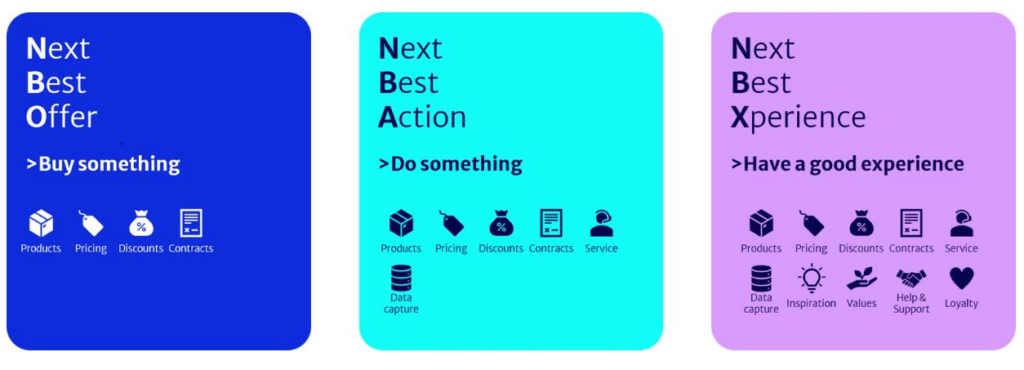
NBO was mostly about getting customers to buy things. It digitised the ‘local shopkeeper’ model of remembering what regular customers like.
The trouble is, Next Best Offer marketing only optimised for the next purchase. It never asked why the customer did something or what they needed.
Next Best Action
Next Best Action marketing is better. It accounts for customers’ preferences and at least makes a show of introducing a service mindset.
But it’s still action-led, optimising for what the brand wants the customer to do next.
Most brands are here today and eager to evolve.
Next Best Experience
Next Best Experience builds on NBA but reframes the question. It layers journey analytics and deep context to decide what the customer should experience next.
Emphasis on experience. It removes the assumption that the customer needs to do something. Having a break from the brand is a viable experience. So is getting a service notification that doesn’t nudge them further down the funnel.
Functionally, it’s also driven more by deterministic automation than probabilistic reasoning. NBX uses reasoning to make in-the-moment decisions, whereas NBA is rules-based and centrally governed.
Putting the customer at the centre of the decision is the core difference. The goal is to leave a positive impression and strengthen the relationship over time.
While it’s not mainstream yet, we’re already working with clients to reframe their CXM approach around NBX principles and best practices.
“Marketers spent 20 years getting really good at sending the right message to the right person at the right time because that was the goal. NBX changes the goal. Now it’s about facilitating the right thing for that customer in that moment, even when the right thing is no message at all.”
Mark Clydesdale
Why Decisioning Had to Evolve
We’ve been hearing that “customers want more” for well over a decade. Now we’re starting to see that they mean it – and they’ll leave when they don’t get it.
- 52% of consumers have stopped using a brand because of a single bad experience.
- 80% say the experience a company provides is as important as its products or services.
- 79% expect consistent interactions across departments, and 73% expect personalisation to improve in line with technology.
Irrelevant experiences cost you just as much as bad ones. McKinsey found 71% of consumers expect personalised interactions and 76% get frustrated when they don’t get it.
The Next Best Experience Approach
NBX is a systematic approach characterised by unified intelligence, contextual insights, adaptable experience catalogues, customer-centric development, and rapid deployment capabilities.
Which is to say: it’s a lot. Especially for mid-sized businesses with tight marketing budgets.
It’s not something you can build in a day, but it’s not as ambitious as you might think.
Step 0: Organisational Alignment
The brass tacks business case for NBX is higher customer lifetime value (CLTV) resulting from better decision-making across the customer lifecycle.
McKinsey found that AI-powered Next Best Experience capabilities:
- Increase revenue by 5–8%.
- Improve customer satisfaction by 15–20%.
- Reduce cost to serve by 20–30%.
This happens because NBX starts with the customer and what they need, not what the business wants to sell. That generates loyalty, which translates to higher CLTV.
Your job is to communicate this mutual benefit message to the right people in your organisation.
Sidenote: NBX Is Not Campaign Management
The NBO to NBA to NBX evolution mirrors a wider shift from from campaign management to experience management. As marketers, we’re on the cusp of having the capability to join up customer journeys and operationalise decisioning at the touchpoint level.
But that only happens when people, processes, data, and technology are aligned. One missing piece, one siloed team, one channel or product group working independently, and the whole thing stalls.
Build an Experience Catalogue
Build a centralised repository of all the different experiences a customer might want to have across brand, sales, and service. Bonus points if you make your asset library modular.
Remember, an “experience” is anything that leads the customer to think more positively about the brand. That encompasses a broad range, from a conveniently located ‘Buy Now’ button to a strategic pause where you give a saturated customer a breather.
Data Quality is Key
Decisioning tools need access to good data to interpret behaviour and contextualise customer signals.
Two “similar” customers with different attributes can interact with the same content in completely different ways. To replicate the most valuable outcome (experience) for similar customers, you need to know why.
At a minimum, you need:
- Personal data such as name, gender, address and supporting demographics.
- Behavioural data including past purchases, service issue, and product holdings.
- Contextual data such as preferences, current browsing, and implied interest.
While contextual data can be the hardest to capture, it’s the most valuable.
If your data is poorly engineered or the attributes aren’t there, decisioning won’t work.
Siloed Data is Bad Data
If you’re only working from marketing data, you’re missing at least 2/3 of the picture. NBX relies on understanding customers as individuals. That means unifying data from marketing, sales, and service, often using a CDP.
Reshaping the Customer Experience Organisation
Next Best Experience demands that the organisation shifts from a campaign mindset to an experience mindset. That means shifting from product-centric to customer-centric.
There are ramifications across the org chart. How and where roles change – and leadership’s influence over the whole show – looks different for each team. In particular, it depends on whether you opt for a central brain or embedded AI model.
The key takeaway is that true NBX cannot work under a classic organisational model with marketing, sales, service, creative, data, and IT all functioning in siloes.
Decisioning Across the Connected Customer Experience
As marketers try to get back to offering personalised customer experience, coordinating seamless journeys, and doing things for customers rather than selling to them, Next Best Experience is emerging as the new way decisioning is done.
For years, NBX has been out of reach for most brands without an enterprise budget and a large in-house development team. Now AI’s rapid advancement has lowered the barrier to entry, enabling more marketers to meet customers where they are.
It’s not a switch you can flip or a tool you can plug in tomorrow. Changing the organisation’s mindset, unifying data, building internal capabilities, and developing an experience catalogue requires a determined and deliberate effort.
But Next Best Experience isn’t marketing theory anymore. And the earlier you start, the sooner you’ll see CLTV increasing.
Risks to Watch Out For
Use AI Wisely
AI often becomes the solution to a non-existent problem in a “hammer in search of a nail” situation.
You don’t need AI. You need a plan to deliver better customer experience. AI will probably be part of that.
Overdesigning the Decisioning Engine
Starting with a perfect centralised brain or real-time personalisation at every touchpoint just isn’t realistic.
Instead, start small and scale. Pick a high-value moment or journey where the current experience is clearly underperforming. Use it as a pilot, apply what you learn to develop your decisioning model, and continuously optimise your approach.
Doing More
Next Best Experience – the new best-practice in decisioning – shatters the assumption that more marketing is always better.
Sometimes, the most valuable experience is a well-timed offer. Other times it means holding back to give customers a breather. Use decisioning to deliver the best experience for the customer.
So, Which AI Decisioning Model Is Right?
There isn’t one answer.
If you’re in a regulated industry, already using a system like Pega CDH, dealing with genuinely complex eligibility logic, or operating where consistency and auditability out-prioritise speed, then a centralised brain is the right call.
If you’re a marketing-led business running on a composable tech stack, blocked by the cost of a centralised implementation, or you want to start delivering personalised experiences in months rather than years, embedded AI gets you there faster.
Before all that, though, you need to get your operating model right. CX squads, performance analytics, AI engineering, data quality, brand governance, and leadership comfortable with sharing control.
That’s the work that pays off, whichever route you pick.
