
Insight
Adobe Summit 2026: AI, Architecture, and the Unglamorous Work of Getting It Right
28 April 2026 Marketing Technology
A few of the Tap CXM team were at Adobe Summit 2026 in April. Here’s what we took away – the announcements, the underlying direction, and what it means practically for teams working on customer experience right now.
The Headline: Adobe CX Enterprise
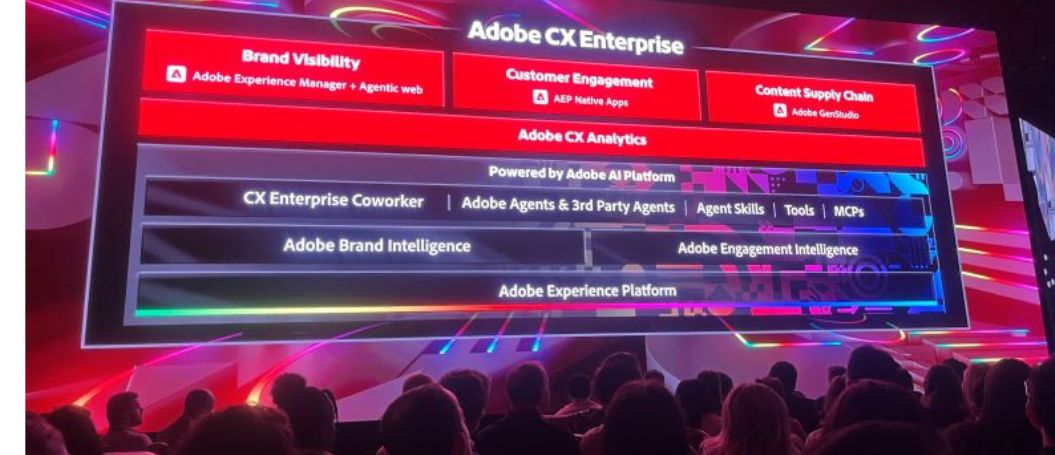
By far the biggest announcement at Adobe Summit 2026 was a rebrand of Adobe Experience Cloud to “Adobe CX Enterprise“.
The move essentially replaces Experience Cloud on-premise and self-managed tools with a single architecture based on agentic AI.
The evolved CX Enterprise platform is organised around three pillars:
- Brand Visibility
- Customer Engagement
- Content Supply Chain
They’re underpinned by a new Adobe AI Platform with two intelligence systems:
- Adobe Brand Intelligence, which governs brand consistency across AI-powered channels.
- The CX Engagement Intelligence System, which handles optimisation across audiences, channels, and customer journeys.
Is your head spinning yet? Ours was. It’s a huge shift from tool-centric marketing software to what Adobe calls “goal-oriented, AI-first workflows”.
Adobe CX Enterprise is an end-to-end agentic system that orchestrates B2B and B2C customer experiences in the AI-driven era… [It] delivers three integrated solution areas that work as one system. Together, they form a single, coordinated approach to customer experience orchestration, powered by a unified AI foundation.
– Adobe.
Within this new framing sits the CX Enterprise Coworker*. It’s a persistent, self-learning agent with enterprise memory that can orchestrate multiple agents, synthesising insights from Adobe and third-party applications.
Unlike a one-shot AI agent that coordinates a single task, Enterprise Coworker runs continuously, coordinating agents and workflows to help teams execute initiatives from campaign launches to retention programmes.
It learns from outcomes, and can be triggered by signals or schedules.
Adobe says it’ll help developers, marketing ops, and marketers alike.
That’s the aspiration.
What it means in practice is that Adobe Engagement Platform (which ‘powers’ Experience Cloud tools to date) is increasingly becoming a system used by AI agents rather than marketers.
Whether you’re ready to hand AI agents that level of control depends heavily on how solid your data and content foundations are. We’ll come to that.
*Update: Adobe announced the general availability of CX Enterprise Coworker on 10 June 2026. It’s offered as a standalone option or add-on for new and existing Adobe customers, with access available at an introductory price and usage-based pricing
B2B Specifically: Marketo Isn’t Going Anywhere
If you work in B2B customer experience management (CXM), there was reassurance on the Marketo Engage front.
The message was clear: Marketo isn’t being wound down or absorbed into something else. It’s being pushed into an AI-first future, like most B2B marketing and lead generation tools.
The most concrete example was the Marketo Engage MCP Server, a way to connect Marketo into broader AI ecosystems and the everyday tools teams already use.
Alongside that, Adobe introduced the Marketo AI Ops Team with purpose-built agents for programme creation, campaign validation, smart list building, lead import enrichment and data normalisation.
- AI associates run 24/7 across marketing operations.
- They integrate with Slack, email, Jira, and Workfront.
- They share context, learn from what happens, and can be triggered or scheduled.
The pitch is more capacity without adding headcount or burning out the people you have.
The Marketo MCP Server also positions Marketo as a hub in agentic martech stacks, enabling agent-to-agent communication rather than keeping Marketo isolated as a campaign execution tool.
Adobe Journey Optimizer B2B Edition is also continuing to evolve with smarter decisioning, richer personalisation, and tighter connection between planning and execution. The trajectory is clear: we’re moving from campaign-by-campaign execution toward something more like orchestrating an always-on system
The Broader Shift: AI & Humans Marketing to AI & Humans
One of the more thought-provoking moments in the keynotes came from Jensen Huang of NVIDIA. His point – using radiology as the example – was that AI isn’t replacing professionals, it’s making them busier. Radiologists aren’t being replaced; they’re processing more because AI handles volume. Marketing is moving the same way.
The volume and speed of content that AI enables raises the bar for how experiences are created, managed, and delivered. We’re also, increasingly, creating content that needs to be found and understood by AI systems, not just humans. That’s a shift in how you think about what “good” looks like.
The gap most teams face isn’t awareness of this direction. It’s execution. Knowing where things are going is the easy part.
The Question That Kept Coming Up: Build vs Buy
If there was one theme running through conversations with clients and peers across the week of Adobe Summit 2026, it was this.
Some organisations are going deep on the Adobe stack, committing to a single integrated environment. Others are building selectively where they want more control or differentiation, and buying where they don’t.
Neither is inherently right or wrong. The answer depends on how Adobe tech meets your organisation’s requirements, and where AI fits in your competitive advantage. It’s hard to make that decision coherently when every platform in your stack (CDP, CEP, CRM, CMS) now has an AI layer and claims a central role.
The truth is, Adobe isn’t the only option.
- Salesforce has been building out its Einstein and Agentforce capabilities across Sales Cloud, Marketing Cloud, and Data Cloud.
- Microsoft is layering Copilot throughout Dynamics and the Power Platform.
- Platforms like Braze, Segment, and HubSpot are all moving in the same direction.
The question of which platform “owns” AI-driven decisioning isn’t one any single vendor gets to answer unilaterally. And for most organisations, the stack is already mixed.
The risk is ending up with overlapping capabilities, unclear accountability, and integration debt that slows everything down. That’s as true for a full Adobe shop as it is for anyone running a best-of-breed mix.
The Less Glamorous Reality
A lot of what was discussed at Adobe Summit 2026 is genuinely impressive. And the fact they’ve backed it up by releasing CX Enterprise Coworker less than 3 months later says something.
But organisations need to sort out the basics first before jumping headlong into coworkers and agents.
AI doesn’t resolve issues like disconnected data or journeys built around internal structures (rather than how customers actually move). It tends to amplify them.
If the underlying foundations are weak, agentic AI surfaces that immediately.
So the real work is a bit less headline-worthy:
- Getting data in order.
- Making deliberate calls on where you’re happy to cede control and where you’re not.
- Working out how to govern a stack where every vendor now wants to be the AI layer.
- Running it without things breaking.
That’s a significant part of what we’re working through with clients right now. The opportunity is substantial. So is the complexity. The two tend to arrive together.
Worth Saying: This Isn’t New To The Industry
For anyone who’s been watching this space, the direction Adobe is moving will feel familiar.
Adobe, Salesforce, HubSpot, and others are all converging on a similar vision of platforms that act less like interfaces for human users and more like infrastructure for AI agents and automated workflows.
Salesforce was making similar announcements at Dreamforce in 2024, with autonomous agents, AI-driven journey orchestration, platform-level intelligence. Other vendors have followed since.
What’s notable about these Adobe Summit 2026 announcements is that the capabilities are maturing and the roadmap to concrete implementations is shorter.
It’s reinforcing the expectation that marketing platforms should behave this way as standard.
That matters for how you approach marketing stack investments and team resourcing.
The organisations best placed to take advantage aren’t necessarily the ones who move first. They’re the ones who’ve thought clearly about what they’re trying to achieve, have the data and content foundations to support it, and have made considered calls about which platforms to trust with which decisions.
We work across Adobe, Salesforce, and a range of other platforms, and the underlying questions are the same regardless of which vendor you’re working with.
